

Cold Chain Transport Insulated Tarpaulins: How the Insulation Layer and PVC Cover Work Together - Structure, Thermal Logic and Cleaning Requirements
Frozen food, pharmaceuticals and fresh produce fail not just when the refrigeration unit breaks - they fail at the tailgate. Every minute an open reefer door stands during loading, warm moist air pours in, frost builds, and cargo temperature drifts outside the −18 °C cold chain window. A rigid insulated truck box helps, but the door opening and the cargo stack itself are where heat leaks. The answer is a properly specified
a multi-layer thermal blanket that combines a food-grade PVC outer skin with a dedicated insulation core.
This guide explains how a cold-chain insulated tarp actually works, what to specify, what sizes are standard, and how it installs and cleans.

How the Insulation Layer and PVC Cover Work Together
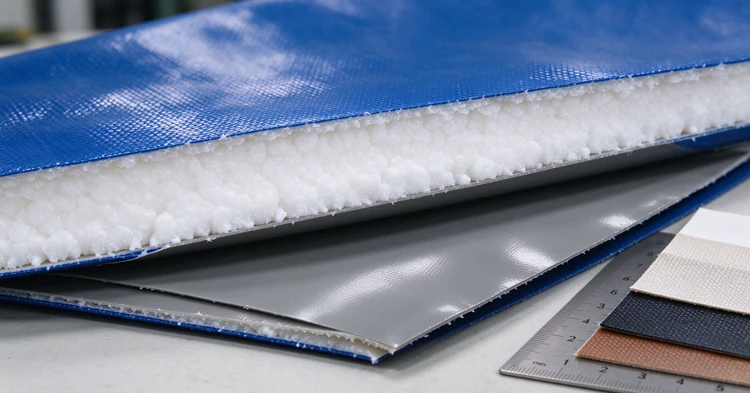
A cold-chain insulated tarp is not a single sheet. It is a sandwich of three bonded layers:
Outer PVC skin - a 610–900 gsm PVC coated polyester fabric that is waterproof, wipe-clean, food-safe and UV-stabilized. It sheds rain, blocks dust and forms the vapor barrier.
Insulation core - closed-cell PVC/PU foam or polyester wadding (holofiber) laminated between the skins. This is the actual thermal barrier; typical R-value is about R-4 per inch of thickness.
Inner food-contact liner - a smooth, low-friction PVC or PE-lined surface that does not shed fibers onto food and can be sanitized.
Cold-resistant plasticizers in the PVC formula keep the material flexible at −40 °C to −50 °C, where ordinary PVC turns brittle and cracks. Welded double-sealed seams eliminate stitch holes that would let moist air migrate.
Technical Specifications
|
Parameter |
Specification |
|
Construction |
3-layer sandwich: PVC skin + foam/wadding core + inner liner |
|
Outer PVC weight |
610–900 gsm, double-sided coated |
|
Insulation core thickness |
5 mm (light duty) / 10 mm (standard) / 20 mm (heavy duty) |
|
Overall blanket thickness |
~4 mm to ~25 mm |
|
Thermal performance |
Blocks >80% heat infiltration at the door opening; R ≈ R-4 per inch |
|
Temperature range |
−40 °C to +50 °C (arctic grade down to −50 °C) |
|
Seams |
Hot-air welded, double-sealed |
|
Surface finish |
Smooth matte, food-grade cleanable |
|
Flame retardancy |
B1 / M2 / UL 94 V-0 option |
|
Anti-mildew / anti-bacterial |
Treated for food and pharma contact |
|
Tear strength |
250–500 N |
|
Waterproof |
100% |
For refrigerated truck curtain use at the door opening, a flexible PVC strip curtain in 2–4 mm thick, 200–400 mm wide strips with 50–60% overlap is often added behind the insulated blanket for self-closing traffic flow.
Standard Finished Sizes
|
Application |
Common Finished Size |
Notes |
|
Light van insulated cargo cover |
2.4 m × 1.8 m, 3.0 m × 2.0 m |
Small box van, home delivery |
|
4.2 m reefer truck tailgate curtain |
2.2 m × 2.2 m |
Hangs at rear door opening |
|
6.8 m / 7.6 m truck side-curtain box |
Curtain side: 6.5 m × 2.5 m each side |
Insulated rolling curtain |
|
13.7 m / 16.5 m semi-trailer |
13.4 m × 2.7 m per side; rear 2.5 m × 2.7 m |
Insulated curtain-side trailer |
|
Reefer door strip curtain |
2.0 m × 2.2 m, 2.4 m × 2.6 m |
Trim-to-fit |
|
Insulated cargo blanket / stack cover |
2.0 m × 3.0 m, 2.4 m × 3.0 m |
Pallet or full-stack cover |
|
Pharmaceutical door curtain |
Custom opening size |
Anti-static / cleanroom option |
All finished units ship with reinforced perimeter webbing, eyelets or D-rings every 30–50 cm, weighted bottom hems, and - for door curtains - a heavy-duty zipper or split opening for walk-through.
Installation Methods
1. Hanging tailgate / door curtain. The insulated blanket hangs from an overhead stainless or powder-coated rail mounted above the reefer rear door, with a weighted bottom hem. Split down the middle with a heavy-duty zipper so operators can part it to walk through. This is the standard reefer thermal cover for dock and loading-bay protection.
2. Curtain-side trailer replacement. On open curtain-side trucks, the insulated PVC panel slides on an aluminum overhead track and ratchets shut along the base rail, replacing a single-purpose weather tarp with an insulated version.
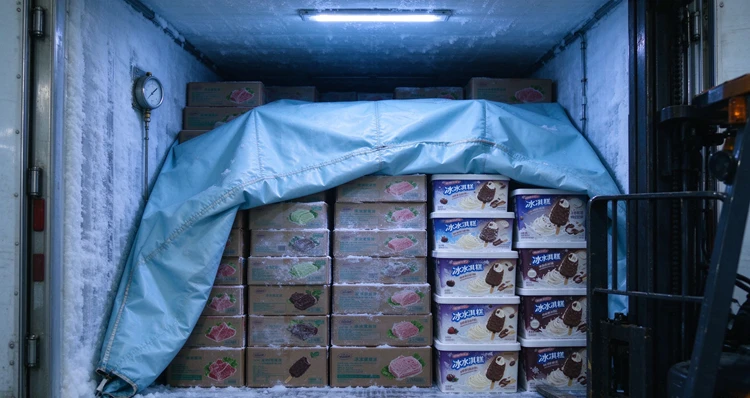
3. Pallet / cargo stack blanket. A lightweight insulated cover drapes over a stacked pallet or mixed cargo load inside an unrefrigerated truck, bridging gaps between the cargo and the cold air flow. Secured with straps or cam buckles.
4. Strip-curtain secondary seal. Clear arctic-grade PVC strips clip to a stainless rail behind the insulated blanket, self-opening for forklift traffic and closing immediately after - the highest-traffic solution for cold chain logistics tarp operations.
5. Magnetic / quick-release edge seals. Magnetic strips along the frame edge on smaller vans snap the blanket flush to the door opening, eliminating side gaps.

The Three Operating Rules
Temperature window
Specify the arctic-grade −40 °C formula for frozen cargo; the standard −20 °C formula is adequate for chilled (+2 °C to +8 °C) produce and pharma. Never use a general-purpose truck tarp - it will crack and delaminate in frozen service.
Cleaning and hygiene
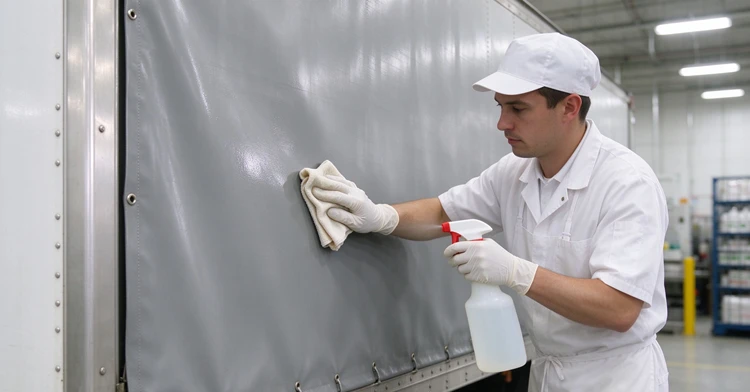
Food-grade PVC surfaces must be washable: wipe with neutral detergent or food-grade sanitizer, rinse, and air-dry before folding. Never fold a wet insulated blanket into storage - trapped moisture grows mold inside the foam core and destroys the thermal layer. Inspect seams after each wash for delamination.
Seam and edge integrity
Welded seams are the only acceptable construction for food and pharma service. Inspect D-rings, zipper sliders and weighted hems weekly; a 10 cm gap at the bottom edge negates most of the insulation value.


